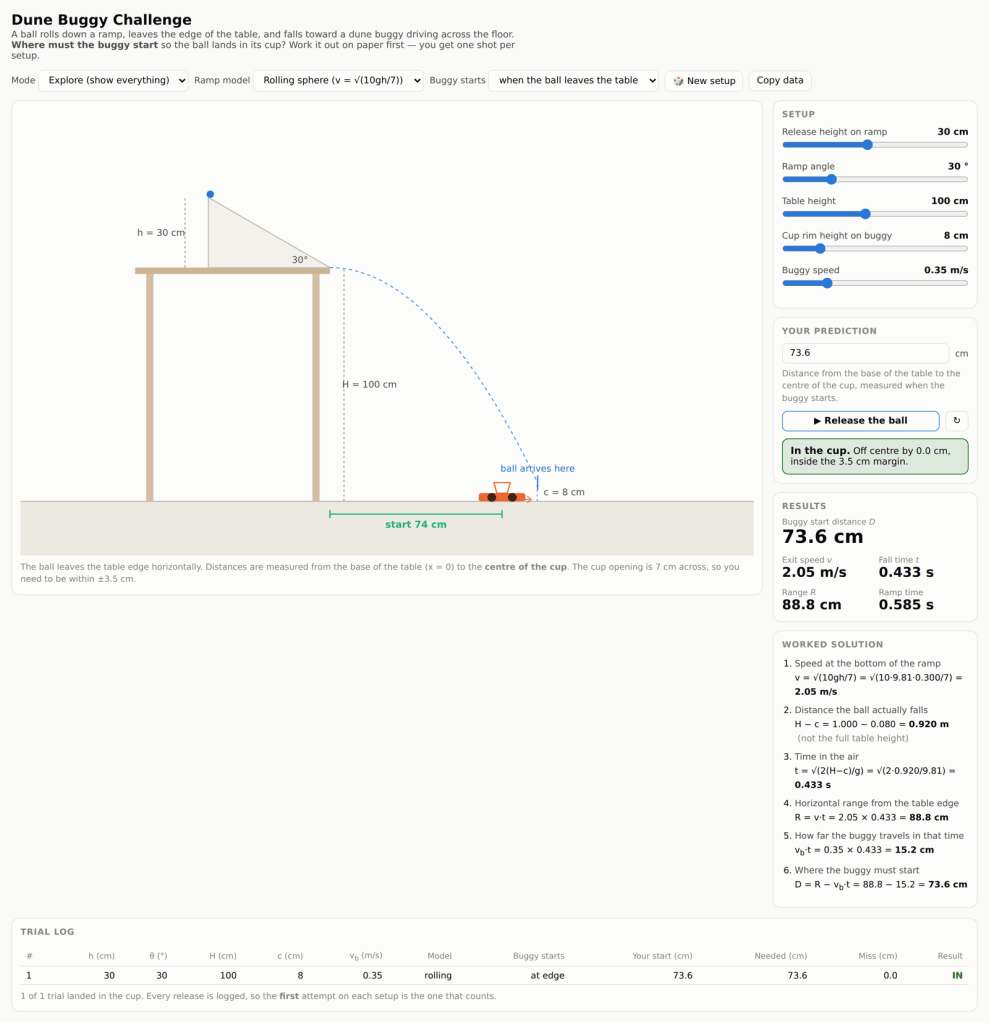
A ball rolls down a ramp, leaves the edge of the table, and falls toward a buggy driving across the floor. Where must the buggy start so the ball lands in its cup? Work it out on paper, then take your one shot.
The challenge
You control five things: how high up the ramp the ball is released, the ramp angle, the height of the table, the height of the cup rim on the buggy, and how fast the buggy drives. Everything else follows from those. Your job is to predict one number — the distance from the base of the table at which the buggy must start — and then release the ball and find out whether you were right.
The cup is 7 cm across, so your prediction has to be good to within about three and a half centimetres. The lab reports the miss in centimetres and tells you which way you were wrong, and every release is written to a trial log you can copy into a spreadsheet.
Two things that catch people out
The ball does not fall the full height of the table. It has to reach the rim of the cup, which sits some distance off the floor, so the drop is the table height minus the cup height. Forgetting this is the single most common error in the original hands-on version of this lab. At the default setup — a one-metre table and an eight-centimetre cup — it stretches the predicted range by 3.8 cm, just past the 3.5 cm you have to spare, so the shot misses but only barely. Raise the cup and the penalty grows: at a 1.2 m table with a 12 cm cup it is 6.4 cm.
The second is subtler. A ball rolling down a ramp does not arrive at the bottom travelling at the textbook √(2gh), because some of the released potential energy has gone into spinning it rather than moving it forward. For a solid sphere the exit speed is √(10gh/7), which is only about 85% of the ideal value. The lab defaults to this rolling model and lets you switch to the ideal one, so you can see for yourself how far the simpler assumption throws the shot off — the range comes out roughly 18% too long.
Difficulty and honesty settings
By default the buggy is released at the instant the ball leaves the table, which makes this a clean projectile-motion problem. Switching the release so the buggy and the ball start together turns it into a harder question, because the time the ball spends rolling down the ramp now counts too.
Challenge mode hides the exit speed, the fall time, the range, and the answer until you choose to reveal them, and revealing them prints a numbered worked solution with your own values substituted at every step. The New setup button randomises all five variables, which is the digital equivalent of running several stations at different heights so that groups have to do their own thinking.
For teachers
The lab comes with a printable student packet. It runs a full period: the pre-lab derivations in symbols, a worked example to check that groups are reading the sliders correctly, two predictions to hand in, a trial log, and a section comparing the rolling model against the ideal one. A separate answer key gives the full algebra with numbers, flags the mistake students are most likely to make at each step, and suggests timings. The key is password-protected so it does not turn up in a student’s search results — if you teach this and would like the password, get in touch and I will send it over.
Adapted from the Dune Buggy Challenge Lab by The Physics Classroom (2009), which drops the ball straight down onto a constant-motion cart. Rolling it off a ramp and over a table edge turns it into a two-dimensional problem. Direct link: brandoncomella-afk.github.io/physics-sims/dune-buggy-challenge.html

